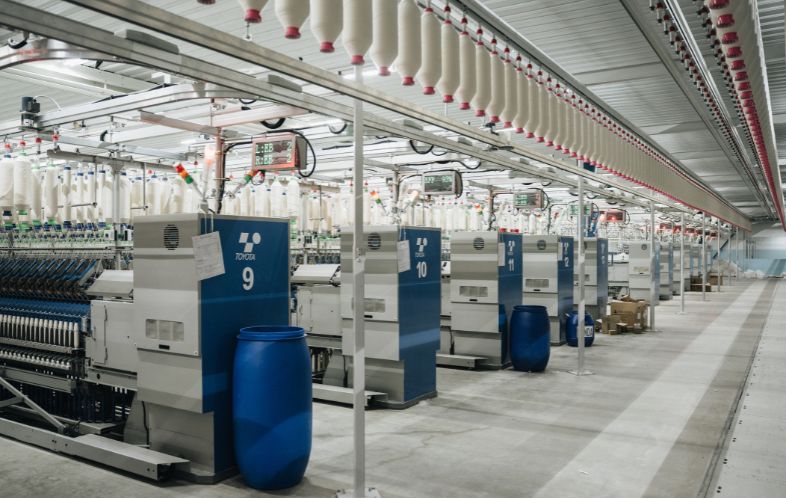
How Ring Frames Convert Roving into Yarn: The Step-by-Step Process
In textile manufacturing, a seemingly simple thread actually undergoes a surprisingly long sequence of operations. Before it is ready for weaving or knitting, fibers must be processed in stages to achieve the appropriate strength, fineness, and uniformity. One crucial stage in this workflow is ring spinning, which uses a ring frame to transform roving into yarn.
What Is a Ring Frame in the Textile Industry?
Definition of Ring Frame
A ring frame is a spinning machine used during the yarn spinning stage to process roving into finished yarn. In this process, roving—which has previously been attenuated (drafted) and given a slight initial twist—is further drawn out and twisted to form yarn with the desired physical characteristics.
In the ring spinning system, the ring frame serves as one of the most critical machines because it directly determines key yarn properties, including yarn count (size), tensile strength, fineness, and overall uniformity.
How Does the Ring Frame Process Convert Roving into Yarn?
1. Roving Enters the Ring Frame
Before entering the ring frame, raw fibers pass through preliminary stages such as opening, cleaning, blending, carding, and drawing. At the roving stage, the fibers are thinned out and imparted with a light twist to give them sufficient strength to be processed in the subsequent spinning phase.
This roving then serves as the primary feedstock fed into the ring spinning machine for conversion into yarn.
2. Drafting Attenuates the Roving
Inside the ring frame, a drafting system featuring multiple pairs of rollers draws out the roving in controlled stages. This reduces the fiber mass per unit length until the precise level of fineness is achieved.
The drafting process must be meticulously controlled, as it directly affects yarn size consistency. A precise draft ensures yarn with a more uniform count and structure.
3. Twisting Forms the Yarn Structure
Following drafting, the fibers are twisted. In ring spinning, this process relies on the synchronized operation of the spindle, ring, and traveler to impart twist to the fiber strand.
Twisting binds the individual fibers tightly together, creating a stronger and more cohesive yarn structure. The amount of twist applied is a key factor governing yarn performance and characteristics in downstream manufacturing.
4. Yarn is Wound onto a Bobbin
The newly formed yarn is continuously wound onto a bobbin (or cop). At this point, the material has successfully transformed from roving into spun yarn ready for the next production stage.
Following the ring frame, the yarn typically moves to the winding process, where it is transferred onto larger packages suitable for industrial use, such as cone yarn.
Also Read: Why Does the Textile Industry Need to Be More Sustainable? Here Are 6 Reasons
Why Is the Ring Frame Essential in Yarn Production?
Determining Yarn Quality and Consistency
The ring frame does not merely convert roving into yarn; proper settings for drafting and twisting dictate the final physical attributes of the yarn. Consequently, this process requires high-precision machinery backed by rigorous, consistent quality control.
In modern textile manufacturing, yarn quality must be monitored across multiple key parameters, including yarn count, count CV%, tensile strength, hairiness, and overall uniformity. Danar Mas Group conducts comprehensive yarn testing in its laboratory facility using advanced testing equipment to ensure product quality and consistency remain uncompromised.
Ring Spinning Technology at Danar Mas Group
At Danar Mas Group, the ring spinning process is powered by advanced machinery such as the Toyota RX300, Toyota RX240, Toyota RX220, and Laksmi LR9. These technologies are deployed to yield high-quality yarn with excellent twist stability before the yarn proceeds to the winding stage.
Leveraging state-of-the-art production technology, combined with multi-stage quality control, helps guarantee that the resulting yarn meets consistent performance standards for diverse textile requirements.
Ring Frame: A Vital Stage Before Yarn Is Ready for Use
The ring frame is a fundamental pillar of the spinning process, as it is the exact stage where roving is converted into yarn with precise, highly specific characteristics. From drafting and twisting to final package forming on the bobbin, every step demands tight operational control to produce uniform yarn.
Understanding the ring frame process provides valuable insight into how yarn quality is engineered right from the spinning stage. If your manufacturing setup requires high-quality yarn tailored to your specific production needs, contact Danar Mas Group to discuss your requirements.